Why Hermes Can't Beat OpenClaw
Hermes wins on memory. But multi-agent is where OpenClaw is genuinely ahead, and the gap is architectural, not cosmetic.
Hermes is sitting at #1 on OpenRouter right now.
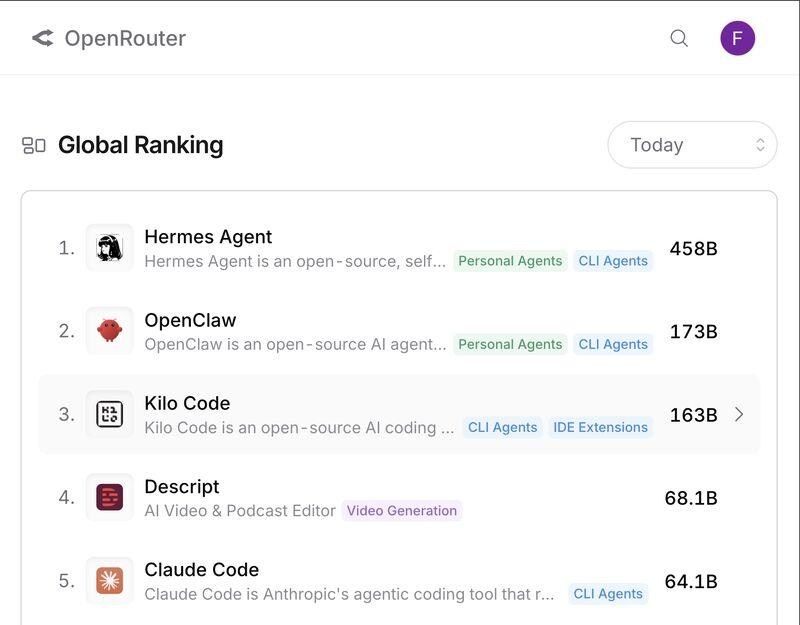
458 billion daily tokens. OpenClaw is behind at 173 billion.
i've used both extensively. and i'll say it straight: Hermes wins on memory. genuinely. every session indexed in SQLite, relevant context pulled before each response, the agent gets smarter the more you use it. that's real.
but memory is one dimension.
here's the dimension people aren't talking about.
multi-agent in Hermes is delegation
when you add multiple agents in Hermes, what you're actually building is one brain that assigns tasks to itself differently.
subagents in Hermes don't have their own persistent memory. they inherit the parent's context. they don't have their own personality definition, their own tool scope, or their own independent lifecycle. you write instructions that say "when handling X, behave like this." then the parent agent follows those instructions when spawning the subagent.
when the task ends, the subagent is gone. nothing persists. the parent holds all the state.
this works for simple task routing. it breaks down when you want agents that are genuinely independent from each other.
what agent separation looks like in OpenClaw
every agent in OpenClaw gets its own directory. four files inside it:
- SOUL.md — personality, tone, how the agent communicates
- MEMORY.md — what it remembers. not full transcripts, just durable facts and learned preferences
- AGENTS.md — behavior rules, when it activates, what workflows it runs
- IDENTITY.md — how the gateway knows to route messages to it
that's the architecture for each agent. not the whole system. each one.

you can run five agents on one gateway. each one connected to a completely different channel.
one handles your Telegram. one lives in your Slack workspace. one monitors a GitHub repo. one does async research. one coordinates the others.
they don't share memory. they don't share personality. they don't know what each other is doing unless the coordinator explicitly routes information between them. if one crashes, the others keep going. adding a sixth agent means creating a new directory. it doesn't touch anything else.
channel separation is the real unlock
this is the part that changes how you build.
when agents have proper channel separation, they can specialize at the interface level, not just at the prompt level.
your Telegram agent can have a quick, casual tone because it lives in a mobile chat context. your code agent can be terse and precise because it operates in a terminal. your research agent can think in longer chains because nobody is waiting on a reply right now.
in Hermes, subagents run through the parent's context and memory. you can tune their behavior with instructions, but they're still one organism. the parent's understanding of the world is the only understanding.
in OpenClaw, each agent has its own understanding. its own history. its own way of operating. when your Telegram agent learns something about your preferences, that knowledge stays in its MEMORY.md. it doesn't leak into the code agent.
agents as peers, not as delegated tasks. that's the design difference.
where this matters in practice
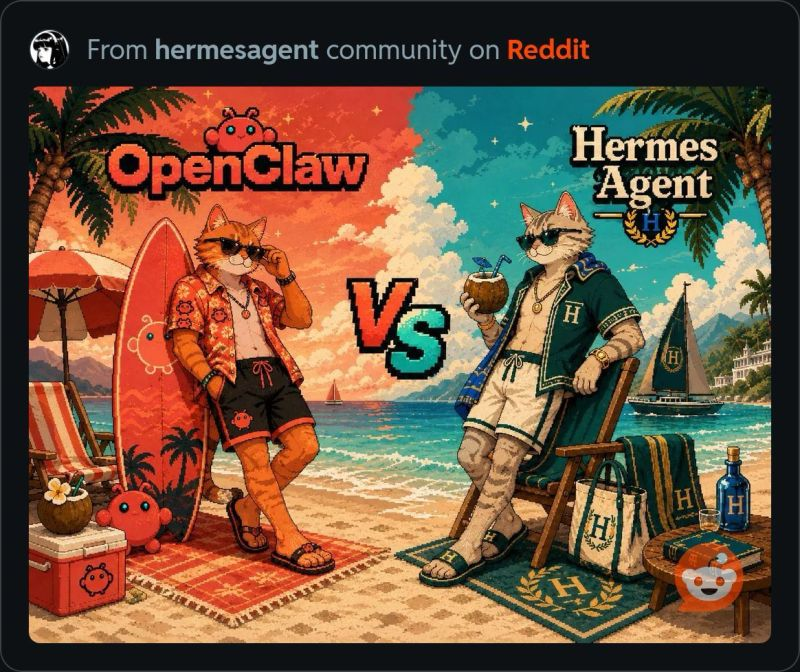
i ran both setups on real hardware.
Hermes on Termux was genuinely fast to get running. the self-learning works. for a single personal agent that knows you better over time, it's the right choice. but when i tried to build true isolation between agents, the architecture pushed back. they shared too much. iota, my orchestrator, ended up holding context that was meant for ghost, my code agent. you end up working around the design.
OpenClaw takes longer to configure. the file system is the API, which means setup is deliberate. but once each agent has its own identity and memory, they don't interfere with each other. my Telegram agent doesn't know what my code agent worked on yesterday. my research agent builds its own knowledge base over time, separate from everything else. that isolation is structural, not something i have to maintain manually.
one more thing about that 458 billion number
OpenRouter ranks by total token consumption, not users.
Hermes requires two LLM calls per response by design. one to retrieve and summarize past context from the SQLite database, one to respond. every single response, every single time. that's why the memory is genuinely powerful, and it's also why the token count climbs fast.
OpenClaw writes to a flat file instead of querying a database before responding. lighter per call. the tradeoff is less continuous learning, more deliberate memory curation.
so when you see Hermes at #1 with 458 billion tokens vs OpenClaw at 173 billion, part of that gap is adoption. part of it is that Hermes burns more tokens per interaction by design.
not better or worse. just worth knowing what you're looking at.
for personal agents that learn: Hermes.
for multi-agent systems with real separation, different channels, different memories, different identities: OpenClaw.
two frameworks built around two different philosophies. now you know both sides.
if you want to see what a production multi-agent setup looks like on actual hardware, i wrote about the five-agent orchestration system that shipped to 200 users on launch day.